CA and tax firms
Every filing for every client has a person and a date, and review does not wait for the last evening.
Firms with two or more partners and 5 to 30 staff: seniors, accountants and articles. Every client has the same filings through the year, from GSTR-1 and GSTR-3B to TDS, advance tax, ITR, audit and ROC. The dates are fixed by law. The work is not: it waits for the client's data, then for the article, then for the partner. The due-date sheet in Excel shows what should happen. It does not show what is stuck, or with whom.
- The due-date sheet is updated by one senior. On the day that senior is on leave, nobody knows the position.
- The client sends the data a day before the due date, and nobody can show when the reminder was sent.
- Review reaches the partners on the last evening, for all clients together.
- An article finishes the term, and the half-done work and the chats with clients go too.
- Fees stay unbilled or uncollected for months, because the people who chase returns do not chase money.
- Notices and one-time jobs are given on a call and get lost among the monthly work.
What we set up for ca and tax firms
Start with the one that hurts most. Each opens as a live demo with sample data. The next one is added only when the first is used every day.
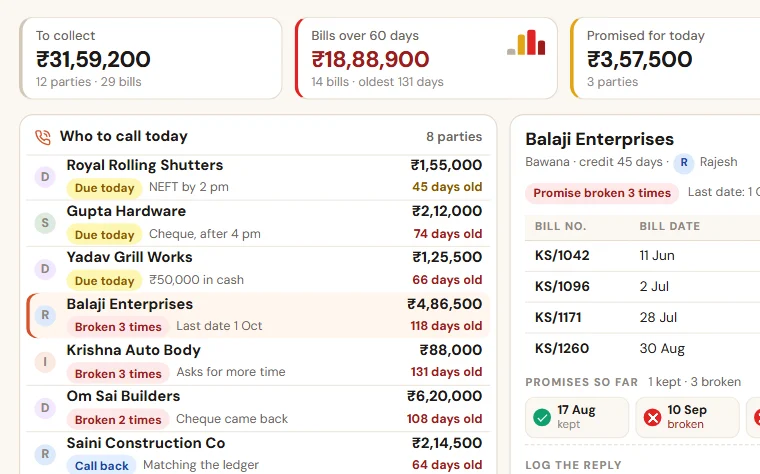
Payment Follow-up
See who to call today, which promise was broken and how old every bill is. Reminders go on WhatsApp, and you see collection salesman by salesman.
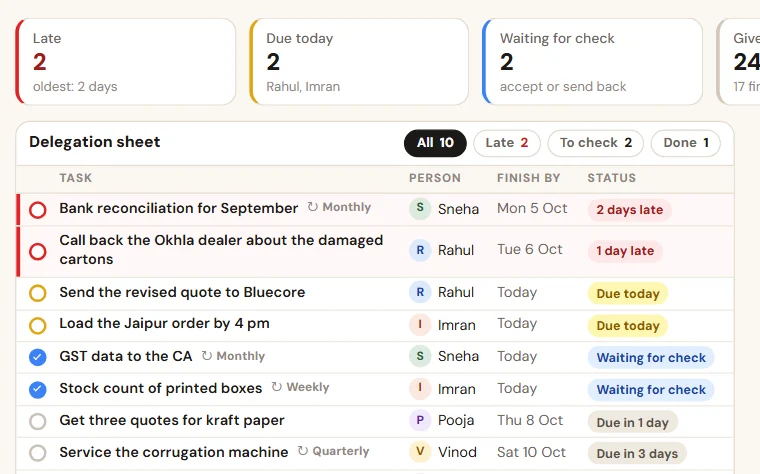
TaskEasy
Give work in ten seconds, see what is late without asking, and get one report of what got done. Checklists for the jobs that repeat.

Compliance Task Tracker
One due-date list of every return for every client, a document checklist per client, WhatsApp reminders for what is missing, and a weekly report.
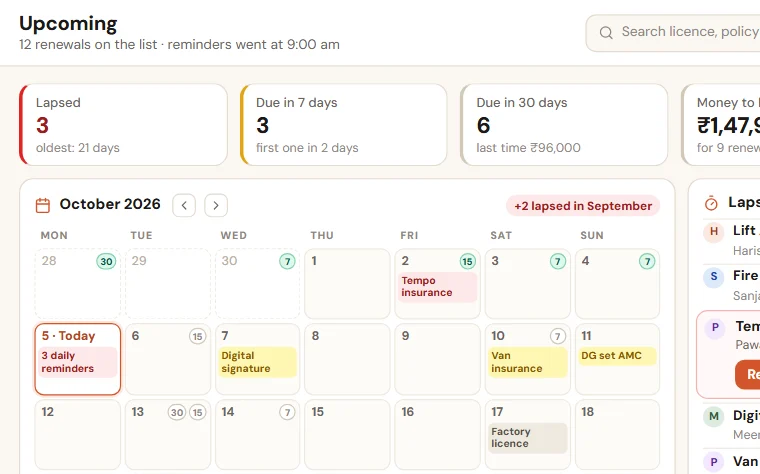
Renewal Reminders
Every renewal date in one list, with one person responsible. WhatsApp reminders go 30, 15 and 7 days before, and every day after, until it is renewed.
How the work runs today
The month has a rhythm that everyone in the firm knows: GST returns, PF and ESI challans, TDS returns after each quarter, and the long jobs of the year in between. A senior keeps the due-date sheet. Articles ask clients for data on WhatsApp, from their own phones. The client says "sending by evening" and sends it four days later.
So on any morning, three questions have no quick answer. Which returns are waiting for the client? Which are with our team? Which are ready and waiting for a partner? The answers exist, but in ten chats and one person's head. Review then arrives in a heap on the last evening, and the partners sign late at night.
What to fix first
Do not start with billing, attendance or a full office suite. Start with the compliance calendar: one task for every filing of every client, with one person, one date and one status. Once that is in daily use, fee follow-up and renewals are easy to add.
What we set up
One process at a time, on your own data, in about two weeks, at a fixed price.
The Compliance Task Tracker opens each task by itself from the calendar your firm sets at the start of the year. Your own date sits a few days before the last date, so there is room to review. Each client has a document checklist, and a reminder for what is missing goes on WhatsApp from the firm's number. Finished work goes to the partner, and comes back with a note if needed. Filed work is closed with its acknowledgement number. The partners get one report a week. Later, Payment Follow-up can chase fees in the same polite way, and Renewal Reminders can hold DSC, registration and licence expiry dates.
What stays as it is
The government portals and your tax and GST software stay. The tracker does not file returns, does not work out due dates from the law and does not keep client passwords. Tally stays for accounts. WhatsApp stays, but reminders now leave a record.
How we work with you
You share your due-date sheet and client list for the current month. We come back with a working demo on those clients. If it fits, you get the scope and the fixed price on one page. Setup, loading clients and filings, and training partners and staff take about two weeks. One senior keeps it updated. After go-live, a small monthly plan covers fixes and small changes.
What ca and tax firms ask us
Is this tax or GST software?+−
No. It does not compute tax or file anything. Filing stays on the portals, with the software you use today. This tracks who is doing which filing, by when, and what is still missing from the client.
Do you need our clients' portal passwords?+−
No. Nothing in the tracker logs in to a portal, and it does not read or keep client passwords. It holds task details, document ticks, notes and acknowledgement numbers.
What happens when a due date is extended?+−
Your firm sets the dates at the start of the year. When the government extends one, a senior changes it once and every task of that type moves.
We are a sole practitioner with two juniors. Is this for us?+−
Probably not yet. With a small team, a shared sheet still works. This helps when there are two or more partners and enough staff that nobody can see the whole position alone.
How long does it take to start?+−
About two weeks for one process, including loading your current data and training your staff. You first see a demo on your own data, before you pay anything.
Is it charged per user?+−
No. The setup has one fixed price and the monthly plan is flat. Add as many staff as you have.
We also set up systems for
See it on your own data first
Share last month of orders, enquiries or tasks. We come back with a working demo, then a fixed price on one page.