Payment follow-up: how to ask for money without spoiling relations
A fixed follow-up calendar, ready-to-send reminder messages and the two questions to ask on every call, so that dues come in and relations stay good.
The material went a month ago, the bill is in Tally, and you are still waiting, because asking feels like begging for a favour. In many firms the party is not the real problem. Follow-up happens only when someone has time, so it is always late and always awkward.
Why asking feels awkward
Asking feels rude when it is late, irregular and personal. A first reminder on day 60, from the owner, sounds like pressure. A reminder from accounts on a fixed day, sent to every party in the same words, is plain office routine.
There is a second reason to ask early. When cash is tight, a party pays the suppliers who ask. Silence is read as "no hurry".
Decide three things first
- The credit period. Agree it when you take the order and print it on every invoice: "Payment due within 30 days of invoice date."
- Who follows up. One named person in accounts, not the owner. Keep the owner's call for later, so that it still carries weight.
- Which days. Messages go on the day they fall due. Calls are made on two fixed days a week, for example Tuesday and Friday. Follow-up that waits for free time does not happen.
A payment follow-up calendar you can copy
| When | Who | What to do |
|---|---|---|
| Invoice day | Accounts | Send the invoice and LR copy on WhatsApp. Mention the due date. |
| 3 days before due date | Accounts | A short reminder with invoice number, amount and due date. |
| Due date | Accounts | A "due today" message with bank or UPI details. |
| 7 days late | Accounts | Call. Ask for a date and write it down. |
| Promised date missed | Salesperson | Call. Ask if there is a problem with the material or the bill. |
| 30 days late | Owner | A personal call. Decide what happens to the next order. |
| 1st of every month | Accounts | Send each party its statement of account and ask them to confirm the balance. |
Change the days to suit your trade. What matters is that every party gets the same steps.
Payment reminder messages you can copy
Before the due date:
Namaste Sharma ji. A small reminder: invoice 2231 dated 4 September for ₹86,400 is due on 4 October. Bank details are on the invoice. Thank you.
After a missed promise:
Sharma ji, you had given 12 October for invoice 2231 (₹86,400). We have not received it yet. Please tell us a date we can note.
Every message carries the invoice number, the amount and the date. It never carries anger, a threat or a long story. Facts are easy to reply to.
On the call, ask for a date
Before you dial, check the party's ledger in Tally. A reminder for a bill that was paid last week does more harm than no reminder.
Do not ask "when will you pay?" Ask "which date shall I note?" Write that date against the invoice, and call again the day after it passes.
Then ask one more question: "Is there any problem with the material or the bill?" A payment is often held back for a reason nobody told you: a short supply, a rate difference, a missing LR copy, a GST mismatch. Settle the dispute and the payment follows.
If the party offers a part payment, take it and note a date for the balance.
What to write down
For every unpaid invoice: party, invoice number, date, amount, due date, last contact, what was said, promised date and next action date. A row without a next action date is a row nobody will follow up.
When the party still does not pay
Say it before the next dispatch, not after: "We will send the next lot as soon as invoice 2231 is cleared." Then shorten the credit period for that party, or ask for part payment in advance on new orders. A clear rule harms the relationship less than months of silent resentment.
Sheet or system?
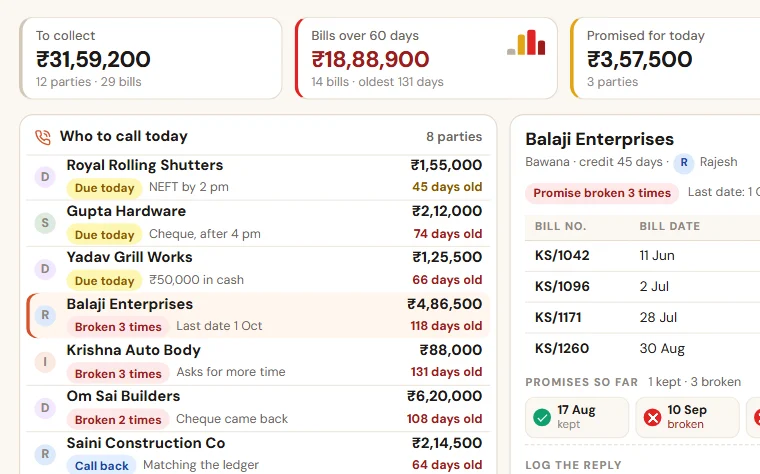
A sheet with the columns above, sorted by due date, is enough while one person can call every overdue party in two sittings a week. It stops being enough when each fresh export from Tally wipes out last week's remarks, promised dates get lost, or reminders go only when someone remembers. That is the stage at which we set up a Payment Follow-up system, which keeps every promised date and works beside Tally.
If payments slip because orders and bills are not tracked in the first place, start with the order register format.
Want to see this on your own data?
Share last month of your data. We come back with a working demo. No payment for the demo.